
Relational strategies build value that lasts
The strongest strategies create value today, while strengthening the conditions from which future value grows.


This article draws on a wide range of my work and projects over recent years. That includes corporate strategy; social policy; systems practice; complexity; and multi-sector partnerships. These domains don’t collide in creative ways nearly often enough, but right now I’m seeing an important set of patterns emerging across all of them.
I’d characterise it as the shift from transactional, to relational world views.
By relational, I do not mean simply having better relationships with stakeholders. I mean recognising that we live and work in relationship: with people, places, ecosystems, institutions, supply chains, communities and time. It’s an important distinction.
We’re getting overfamiliar with the challenge. Our current models of business and government are struggling to keep up with increasing levels of growth and interconnectedness. We’re depleting our baseline capacity to respond to shocks as they occur, leading us more often into crisis (check out Indy Johar’s recent piece for more on this).
This is an invitation to think about how we can flip that script, through building new models of value creation that strengthen our foundations as we go.
We have an often-incomplete model of value creation
We’ve been taught to think of the way we create value in a fairly linear way. We source inputs (land; materials; people; data), we add a differentiating source of value (labour; process; technology; design), and we sell the result as a product, or service at a profit or a surplus to invest back into the business. These are the visible parts of our process, that feel manageable and measurable. However, they are by no means the full picture.
Beneath every act of value creation sits a less visible (or at least less countable) layer of conditions that make it all possible. Traditional strategy and economics treat these things as mostly contextual, or as externalities.
What if we were to acknowledge that they are not peripheral at all? What if we recognise them as fundamental to our system of value creation? Our value web.
There are efforts underway to encourage organisations to think this way. TCFD and TNFD are both driving an agenda to measure and report upon some of these things. It’s an important step, but measurement and harm reduction are only a part of the story. Maybe not even the most important part. The more powerful idea is that these things are actually sources of meaningful and enduring value.
We need to understand therefore that value is created not only through what an organisation does, but through the connected system of conditions that make it possible.
Some of the most powerful strategies already understand this.
Compounding value through the strategy flywheel
Jim Collins introduced the idea of the strategy flywheel in Good to Great. In short, it’s the idea that the best strategies are cumulative. They build through repeated effort in a consistent direction, turning small efforts into sustained growth. Each turn of the wheel builds greater momentum.
The exponential growth that we’ve seen in some of the biggest tech platforms around the world shows how powerful this can be. Every search that we run through Google improves the engine. Every time we share an opinion on Facebook or Instagram, we add to the content that draws other people in. Each new LinkedIn connection strengthens the network that keeps us coming back. Each interaction creates some value for the user, while also strengthening the value proposition of the product or service itself in the future.
It’s smart strategy, and it clearly works in certain ways. Those wheels are certainly spinning fast – the question is what is their momentum driving?
Flywheel strategies can be both extractive and regenerative
The flywheel works, but reasonable questions are being asked about how sustainable the big tech strategies are in the long run.
Amazon offers one of the clearest examples of a successful flywheel strategy. Lower prices and greater convenience attract more customers. More customers attract more sellers. More sellers increase selection. Greater volume improves the economics of logistics and technology infrastructure. Better efficiency supports lower prices, faster delivery and greater convenience, which attracts still more customers. The system compounds.
The model creates real value for customers and has built one of the most powerful businesses in the world.
The impact is more complicated though when we look at the seller side of the equation. Sellers help to build the marketplace but become increasingly dependent on the platform for access to customers. The platform becomes stronger as more participants join, but those participants have less control over the terms on which they participate.
The flywheel works. But, does each turn strengthen the wider ecosystem of sellers, suppliers, customers, and relationships? Or does it mostly strengthen the platform’s ability to capture more value from that ecosystem?
I’m going to say it’s a little bit from column A and a lot from column B. The limits of these strategies won’t show up immediately, because the costs sit elsewhere in the system and may show up some years in the future.
In the meantime, let’s explore what it would look like to really prioritise long-term system health.
Regeneration in practice
In agriculture, it’s fairly apparent that farmers are reliant on healthy ecosystems to produce food. Even so, a lot of modern farming practices have been organised around a simple input – process – output value chain. Seed and fertiliser in, crops out. The system thrived and spread because it can be highly productive, and has driven the ability of farming to keep up with rapidly growing populations globally. However, what has also become apparent in many areas is that with each cycle, the underlying health of the soil may be degraded.
Some tilling practices disturb soil structure and release stored carbon. Nutrients are extracted without being fully replenished. Biodiversity is reduced. Water retention declines. Over time, farms can become more reliant on higher levels of external input just to maintain similar levels of output.
Regenerative practices reorient the focus from maximising output to strengthening the health of growing conditions; in particular, soil health. This is through a variety of means from reducing soil disturbance, to maintaining groundcover, integrating grazing livestock carefully and restoring natural cycles. Each year the conditions for future growth are being strengthened.
Productivity is still the goal, but the means are very different. Profitability improves as input costs reduce, and maybe even more importantly, resilience is built back into fragile systems.
The next system shock, whether flood, drought, fire or heat, is always just around the corner. But healthier land, with stronger soil structure, deeper root systems, more moisture and greater biodiversity, is generally better able to absorb stress and return to productivity more quickly.
Human systems need healthy ‘soil’ too
This lesson matters for all strategies as we look ahead. Resource scarcity and system shocks are not the black swan events they may have been a few decades ago. The baseline for us is no longer stability, and so strategies that strengthen future conditions for growth are likely to prove more sustainable and resilient in the long run.
Organisations also have conditions that make value creation possible. Capability; infrastructure; relationships; partnerships; goodwill; trust; ecological health; natural resources; connection to community and place. Every one of these represents ‘soil’ for organisations. We sometimes take these things for granted until one day they’re not there anymore. I’ve seen how something like organisational trust can turn from an asset to a liability overnight.
Often these things show up as risks and externalities, if they show up at all. Things to pay attention to, to worry about and to account for. However, if we understand more explicitly the way they contribute to the value we create, we can reshape the way we do business to proactively strengthen them with each interaction.
From transactional, to relational
Tending to organisational soil health is the essence of what I mean when I talk about ‘relational strategy’. Relational strategy is not a softer name for traditional strategy and it’s not another name for good stakeholder engagement. It is about understanding relationship as part of the value-creating system. Instead of asking ‘what can we produce, deliver, or capture?’ we ask ‘what relationships and conditions make sustained value creation possible?’. The measure of success is not only the immediate profit that the work produces, but what new value the work makes more possible for next time.
When these become really powerful is when they are used to consciously drive regenerative outcomes – building resilience and sustainability even as they deliver results today.
This thinking builds on one of my favourite papers in this space already: Creating Shared Value, by Michael Porter and Mark Kramer (2011). Their paper challenged the idea that business value and social value were separate domains. Their core argument was that companies can enhance competitiveness, while advancing societal outcomes, through rethinking products and markets, value chains and local clusters. The next natural step is to look at how shared value creation compounds over time. A regenerative relational strategy asks not just whether commercial and social value can exist together, but whether each turn of the handle also enhances the conditions from which future value will grow.
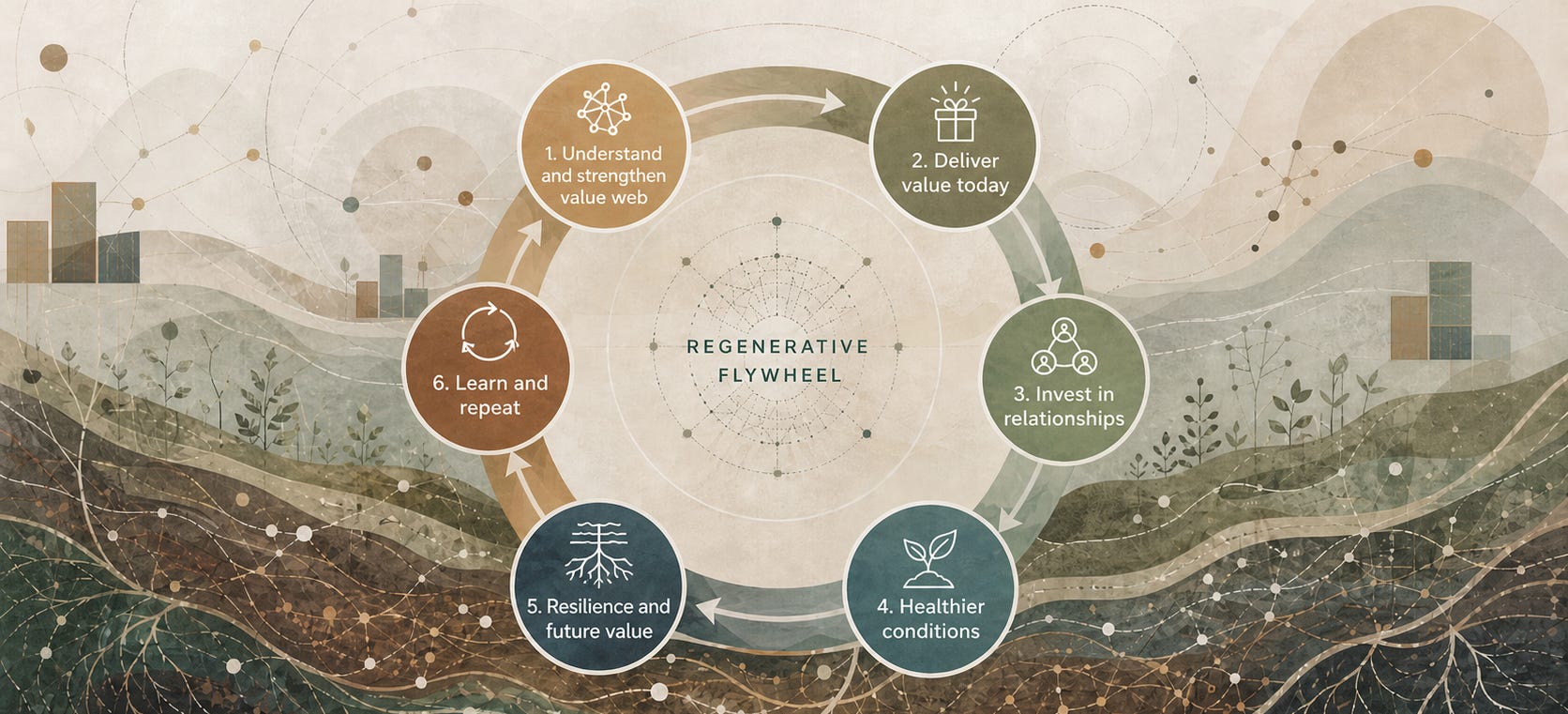
[Image: Illustration of a regenerative flywheel cycle]
From less harm, to more life
Interface, a US-based office carpet manufacturer, is often cited as a great example of a shared value strategy in practice. It also usefully illustrates the opportunity for regenerative, relational strategy.
Interface didn’t just bolt sustainability onto their existing model. They fundamentally reshaped their business model, initially in an effort to reduce their carbon footprint to as close to zero as possible through innovation in materials, process, product and design.
As they neared net zero, they set themselves a more explicitly regenerative vision through their Climate Take Back strategy. The language they use is powerful:
“We need to stop thinking about how to merely limit the damage caused by climate change—and start thinking about how to create a climate fit for life.”
They have been successful – both in beating “Mission Zero” ahead of schedule, but also as a business that continues to thrive.
Their strategy today not only recognises and incorporates the natural systems they are dependent on, but also draws value from its strength and brand as a leader in sustainability, its relationships with suppliers, customers and employees, and its proven track record in sensing, adapting and responding to a changing environment.
The competitive edge of relationality
Porter’s work also tells us that good strategy should compete to be unique, rather than to be the ‘best’ in a given field. That’s relevant here because relationships can’t be created quickly from scratch.
Like neural pathways, relationships are strengthened over time by consistent activity, care and attention. This might seem like a downside, when so many of our drivers encourage fast, visible results. However, relationships that have been invested into and built up over time create sustainable competitive edge because they are so unique and hard to replicate. This is true for human relationships but also for relationships with our supply chains, our environments and the places where we operate.
When relationships are thin, transactional or depleted, value becomes harder to sustain. When they are strong, trusted and generative, value becomes easier to create, more resilient and harder to copy. In a world where products, platforms and processes can be copied quickly, the quality of an organisation’s relationships may become one of its most durable sources of value.
Fertile ground for regenerative relational strategy
Looking back to where we started, there is fertile soil for this thinking in almost every sector. I’ll share some linked examples here.
Government
Relational approaches are asking how different forms of commissioning (like in South Australia’s Child and Family Support system) move beyond thinking about just delivering services through transactional relationships with service providers. They are changing the nature of ecosystems, in ways that help us to solve complex challenges in new ways.
For purpose
Increasingly, organisations are realising the opportunity not only to respond to current need, but to coinvest in strengthening relationships between people, places and organisations and develop durable capability and infrastructure. For example:
Corporate
There is a significant opportunity still to develop relational strategies that look beyond short-term value and into long term conditions for sustainable growth. Especially as shock and volatility becomes the norm, strong relational infrastructure may become the defining characteristic of organisations that can ride the wave and adapt as they go.
For Patagonia, sustainability isn’t the campaign, it’s the model.
AIA Vitality is a health insurance program that rewards customers for healthy behaviours.
Small business and start up
Perhaps the greatest opportunity exists for organisations that are already growing up with more relational ways of working. The ability to remain agile and adaptive through building relational infrastructure and value networks, rather than aiming for traditional growth through scale may prove a significant source of strength.
Growing a relational world view
The opportunity before us is to explore new ways of creating shared value that are more fit for the times we find ourselves in. Ways that don’t treat the environment and social context as externalities, but recognise that they are where we will find many of our risks, opportunities, and unique forms of value creation. For certain, there is a set of capabilities, tools, and processes that will help us along the way but the real shift is in our mental models – our world view around how value is created, and how our purpose coexists alongside others and how we participate in the systems that make our work possible.
This is not a new way of thinking and working. Relationality has been hard wired into humans for millennia. In many ways, what this opportunity represents is a chance to remember what feels forgotten – but which First Nations cultures the world over will remind us has never in fact gone away.
It’s not about going back in time, nor about forgetting what we have learned about the power of competition, markets and technology for enabling coordinated action and rapid progress.
It’s about using the tools already at our disposal, to shift from value capture to value cultivation. Ensuring that we can not only kick goals today, but that we’ll also be able to play the game better next season.
If this has piqued your interest and you’d like to think on it in your own context, these questions are a good place to start:
What value are we creating now?
What relationships and conditions make that possible?
What conditions might we be drawing down?
What conditions are we strengthening for the future?
What future value becomes possible because of this work?
Better yet, drop me a note and come have a chat!
Love these questions! And would love to see more organisations start with those values.
I’m curious about the application of a “flywheel” strategy to regenerative practice and I’m really pleased you’re thinking about the conditions needed for value cultivation vs value capture.
I strongly believe we must tread with caution when selecting tools from the ‘masters’ toolkit, the risk of reinforcing colonial mindsets is too great.
In my research on cartels (including big tech) I’ve taken some time to understand the conditions that allowed Amazon’s flywheel to be so ‘successful’: leveraging copyright law to lock creators and publishers into their platforms and then using incredible monopsony power to exploit and extract to ‘capture value’. (Chokepoint Capitalism by Cory Doctorow and Rebecca Giblin is an excellent source on this).
I believe that Bezos’ flywheel helped set the precedent and passive acceptance for the mass scale exploitation and theft we’re seeing of creative and cultural work via genAI.
Your questions provoke a new way to think about the fly wheel and I deeply appreciate it.